
Methodology

15 prompts to steal for your next study

15 prompts to steal for your next study

15 prompts to steal for your next study

Our research assistant sits inside every study. It has read every interview transcript, the published report, the codebook and the screener data, and it answers your questions in plain language, using your own data. Every number comes back as "X of Y" with a citation you can click straight into the interview behind it, and when the data is silent it tells you so instead of inventing an answer.

Here are 15 prompts worth stealing, from the quick orientation questions to the ones that do real analytical work, including a set that reaches across every study you have ever run. Copy them, change the topic to yours, and see what comes back.

Get oriented

1) "What is this study about?"

Scope, sample and topic in one line, before you open a single interview.
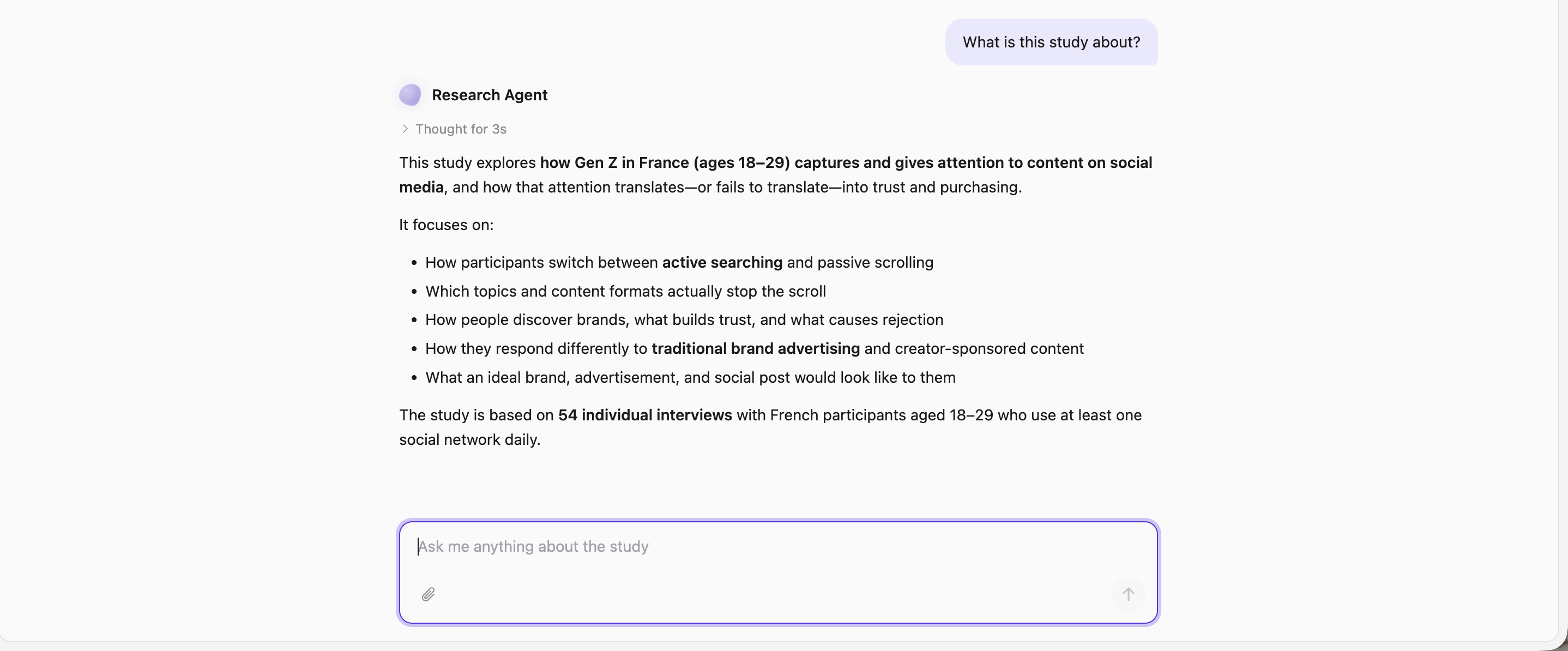
What is this study about?

Find the evidence

2) "Find me quotes from people who don't trust these products, in their own words."

Pulls authentic verbatims on any theme, each with a citation that opens the exact interview.

3) "What share of participants already use the product, and who are they?"

Turns a vague sense into a number shown as "X of Y", with a chip that opens the matching interviews.

4) "What are the biggest pain points?"

Surfaces the strongest points of friction across the whole sample, with the weight behind each one.
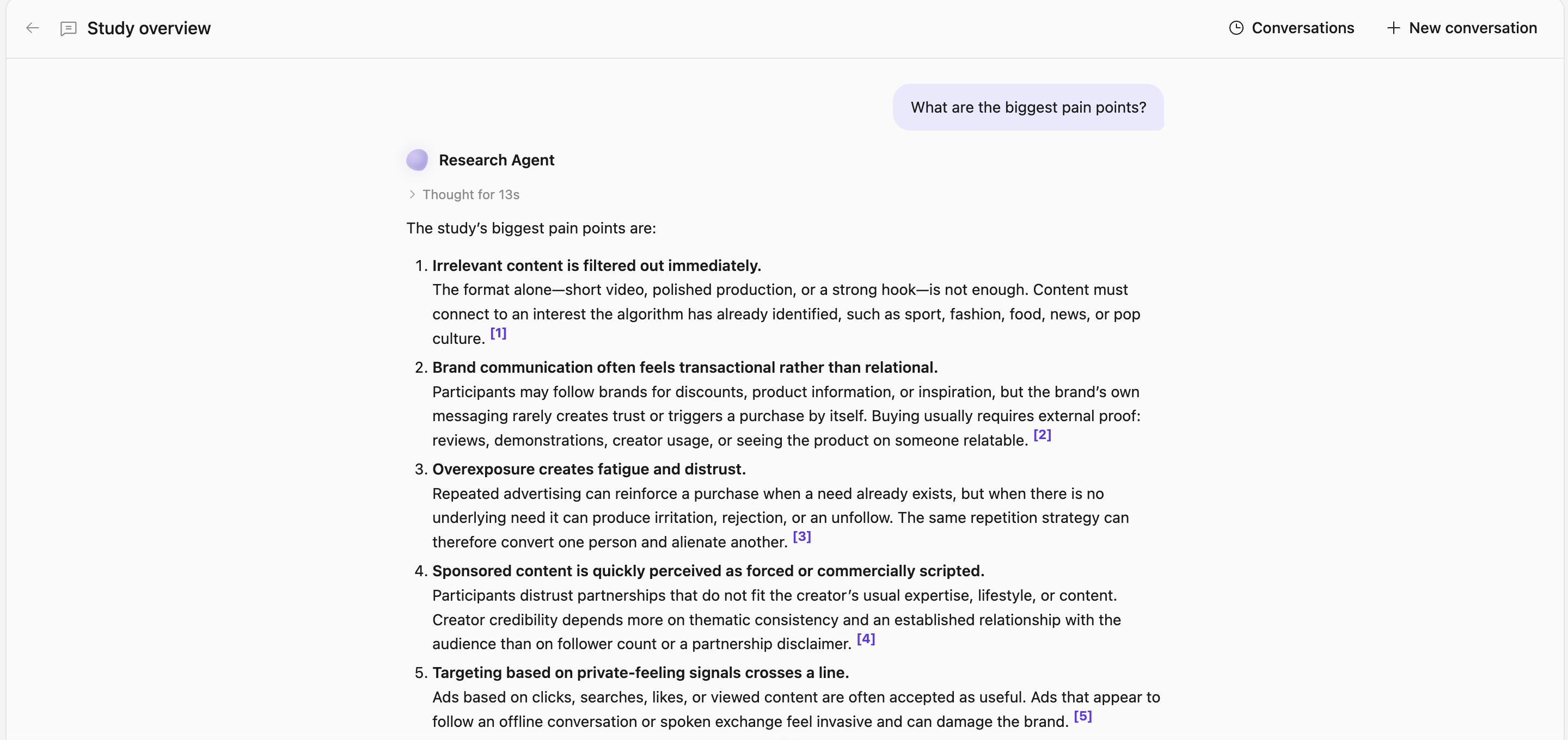
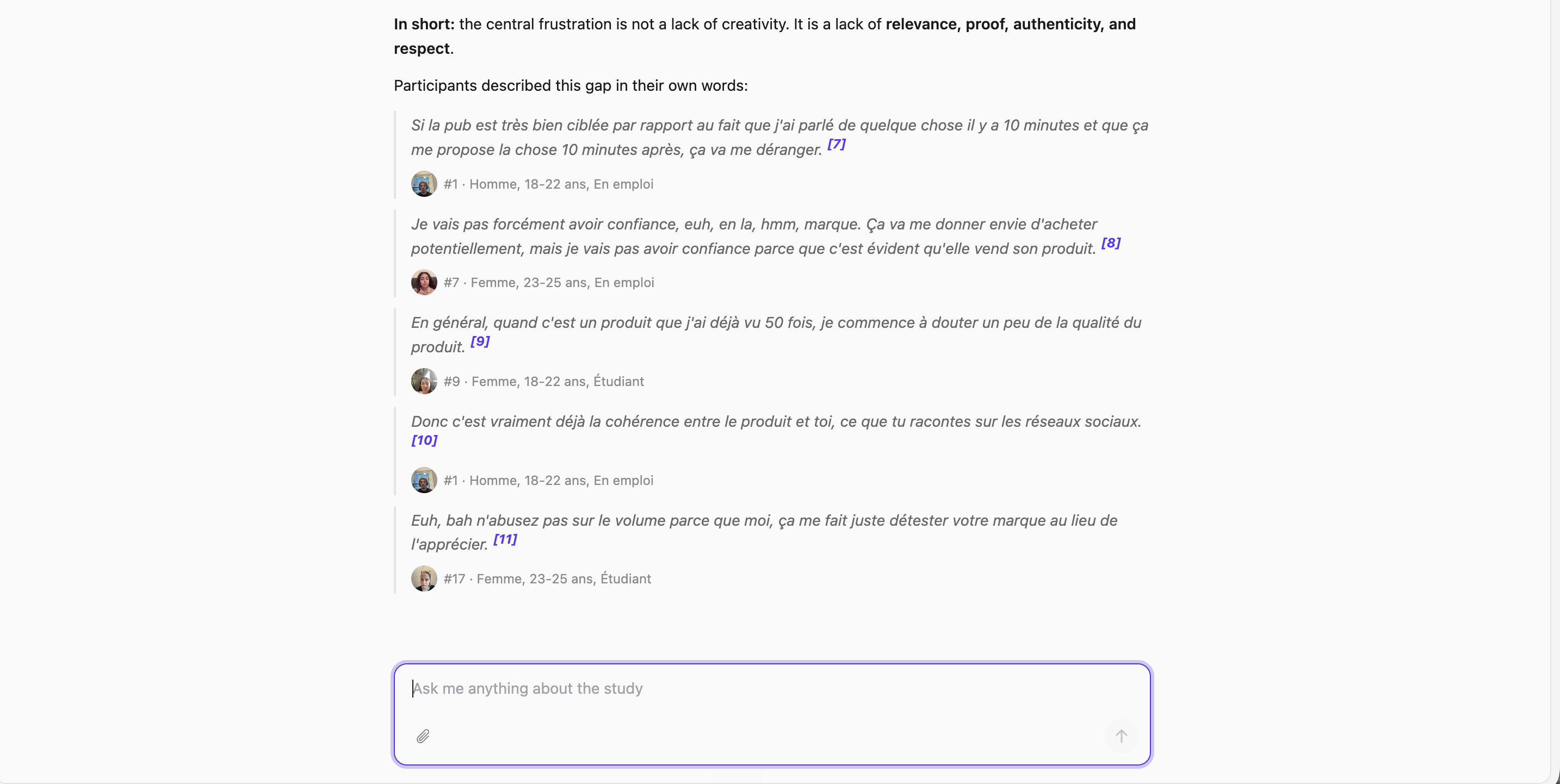
What are the biggest pain points?

Slice and compare

5) "Compare adoption barriers between the 18-22s and the 26-29s."

A cross-tab of two segments on the same question, so you see where they split.
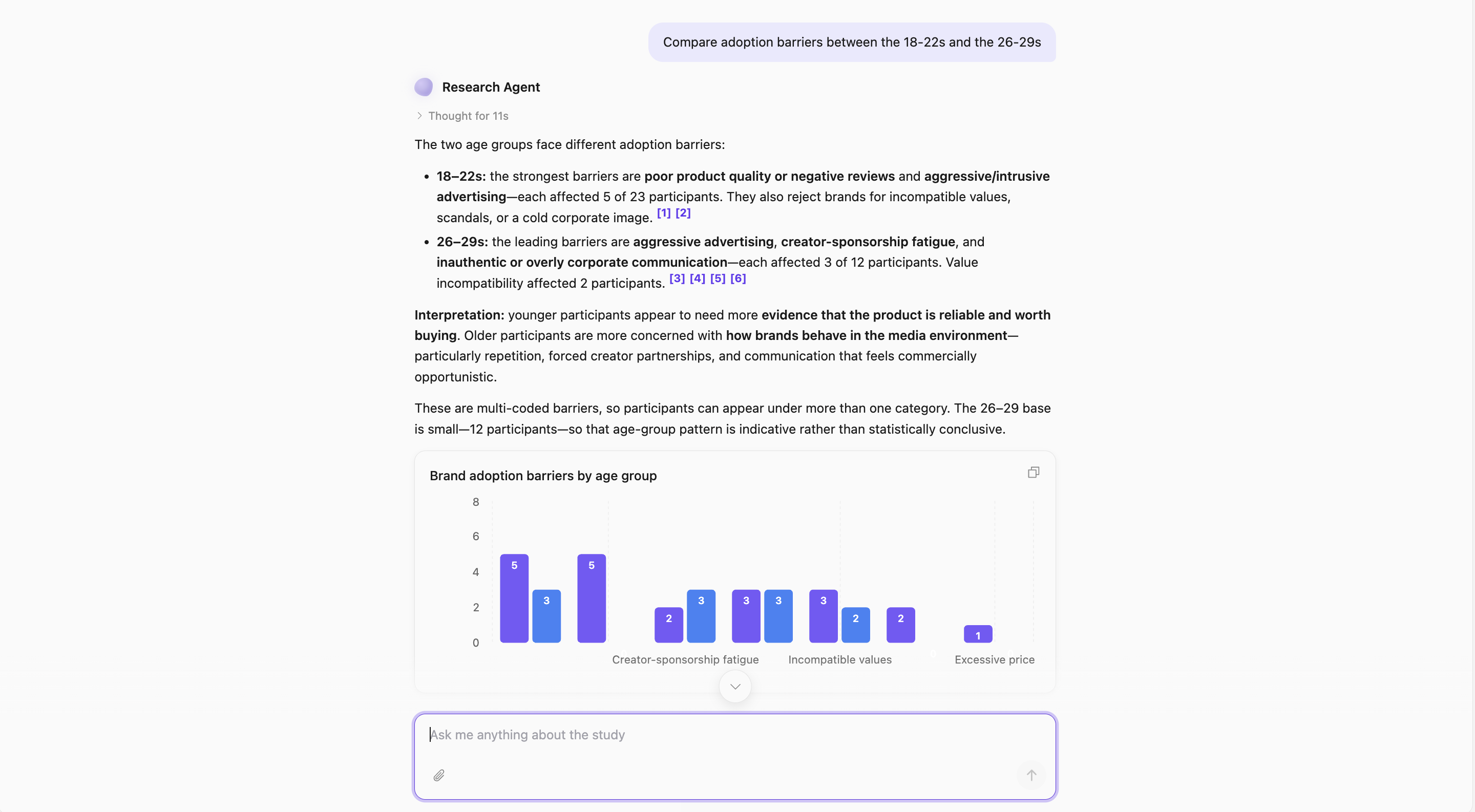
Compare adoption barriers between the 18-22s and the 26-29s.

6) "Go deeper on this finding: why aren't more people adopting?"

Takes one finding and expands it into a full answer built from the report, the codebook and the verbatims.

7) "Set up a coding dimension that groups people by their main reason for buying, then code every interview."

Re-slices the whole study around a new angle on demand, with no manual tagging pass.

Pressure-test it

8) "Cost is the biggest barrier, right?"

State a belief and it checks the data, correcting a wrong premise instead of agreeing with you.

Cost is the biggest barrier, right?

9) "How does our brand stack up against its main competitors?"

Gives the real competitive set from the study, with the criteria where you win and where you lose.

Across all your studies

10) "Across all our studies, what do we already know about price sensitivity?"

Pulls one theme together from your whole back catalogue, so you build on what you own instead of starting from scratch.

11) "Which of our past studies touched on sustainability, and what did each conclude?"

Finds the relevant studies by topic and gives you each one's conclusion, resolving the study names itself.

12) "What did the packaging repositioning study conclude about premium formats?"

Recall a specific past study by name, no ID needed, and get its conclusion on a precise question.

Turn it into output

13) "What are the top three barriers, back each with a quote, and what should we do about the biggest one?"

Bundles several asks into one message and returns a single answer that handles all of them.

14) "What are the top recommendations from this study?"

Frames the strategic implications as "the data suggests", always with the counter-evidence attached.
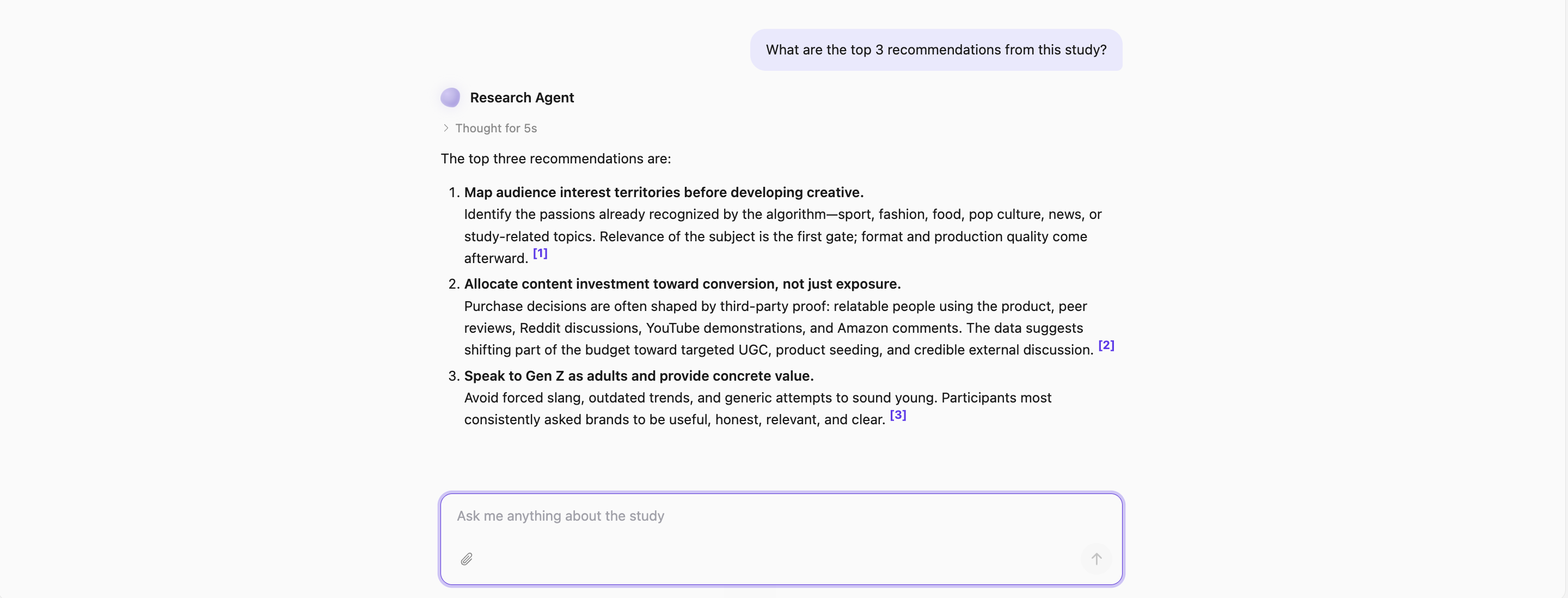
What are the top recommendations from this study?"

15) "Make me a slide from this finding."

Turns a finding, or the whole report, into PowerPoint, ready to drop into the client's template.

The pattern

Every one of these works the same way: ask in plain language, get an answer you can click into, down to the interview behind the number. Take the prompts that fit your next study, change the topic to yours, and let the data answer.

Frequently asked questions

What can the Verso researcher agent do?

It answers questions about a study in plain language, using that study's own transcripts, report, codebook and screener data. It can quantify, pull verbatims, run cross-tabs, test a hypothesis, benchmark competitors, recall findings across past studies, and generate slides, with a citation behind every number.

Can it answer questions across several studies at once?

Yes. When more than one study is in scope, it resolves the study names itself and scopes each answer correctly. You can ask what you already know about a topic across your whole back catalogue, or pull the conclusion of a specific past study by name.

Does it ever make up answers or quotes?

No. It answers only from the data in scope and says so when the data is silent, for example "no participant mentioned that". It does not invent quotes, counts or competitors, and every figure links back to the source interview.

Can it build slides from a study?

Yes. Ask it to make a slide from a finding, or to turn the whole report into a deck, and it generates PowerPoint in the client's template. You can also ask which findings would make the strongest slides before generating anything.

What kinds of prompts work best?

Plain-language questions work best, the way you would brief a research analyst. You can bundle several asks into one message, state a belief for it to check, or point it at a single finding to go deeper. Swap the topic in these 15 prompts for your own.

Verso Team
July 30, 2026
5
min read
The research agent

15 prompts to steal for your next study

Verso's research agent has read every interview, report and codebook in your studies. Ask it anything in plain language. These are the fifteen prompts worth stealing first: copy one, swap in your topic, and see what comes back.

Get a demo Every answer clicks through to the interview behind it.
How the agent works

Plain language in, cited answer out

It is not a chatbot guessing from the internet. It reads your study, and shows its sources.

Grounded in your data

It reads your transcripts, reports, codebooks and screener data. Every answer comes from your own studies, not a generic model.

Cited, not asserted

Each number and quote clicks through to the exact interview behind it. Nothing is left for you to take on faith.

Never invents

It answers only from what's there. When the data is silent, it tells you, instead of filling the gap with something plausible.

15 prompts to steal

A prompt for every stage of a study

They follow the arc of real analysis, from opening a study you've never seen to dropping the finished slide into a deck. Copy any of them.

01

Get oriented

Land in a study you've never opened.

1 “What is this study about?”

Scope, sample and topic in one line, before you open a single interview.

app.askverso.ai · Research agent
The agent summarizing a study
02

Find the evidence

Pull the quotes and the numbers behind a theme.

2 “Find me quotes from people who don't trust these products, in their own words.”

Pulls authentic verbatims on any theme, each with a citation that opens the exact interview.

3 “What share of participants already use the product, and who are they?”

Turns a vague sense into a number shown as “X of Y”, with a chip that opens the matching interviews.

4 “What are the biggest pain points?”

Surfaces the strongest points of friction across the whole sample, with the weight behind each one.

app.askverso.ai · Pain points, and the verbatims behind them
Pain points, surfaced with citations The participant verbatims behind the finding
03

Slice and compare

Cut the sample any way you need, on demand.

5 “Compare adoption barriers between the 18-22s and the 26-29s.”

A cross-tab of two segments on the same question, so you see where they split.

6 “Go deeper on this finding: why aren't more people adopting?”

Takes one finding and expands it into a full answer built from the report, the codebook and the verbatims.

7 “Set up a coding dimension that groups people by their main reason for buying, then code every interview.”

Re-slices the whole study around a new angle on demand, with no manual tagging pass.

app.askverso.ai · Segment cross-tab
A cross-tab comparing two segments
04

Pressure-test it

Challenge a belief and make the data answer.

8 “Cost is the biggest barrier, right?”

State a belief and it checks the data, correcting a wrong premise instead of agreeing with you.

9 “How does our brand stack up against its main competitors?”

Gives the real competitive set from the study, with the criteria where you win and where you lose.

app.askverso.ai · Testing a premise
The agent correcting a wrong premise from the data
05

Across all your studies

Reach into everything you've ever run.

10 “Across all our studies, what do we already know about price sensitivity?”

Pulls one theme together from your whole back catalogue, so you build on what you own instead of starting from scratch.

11 “Which of our past studies touched on sustainability, and what did each conclude?”

Finds the relevant studies by topic and gives you each one's conclusion, resolving the study names itself.

12 “What did the packaging repositioning study conclude about premium formats?”

Recall a specific past study by name, no ID needed, and get its conclusion on a precise question.

06

Turn it into output

Go from finding to something you can send.

13 “What are the top three barriers, back each with a quote, and what should we do about the biggest one?”

Bundles several asks into one message and returns a single answer that handles all of them.

14 “What are the top recommendations from this study?”

Frames the strategic implications as “the data suggests”, always with the counter-evidence attached.

15 “Make me a slide from this finding.”

Turns a finding, or the whole report, into PowerPoint, ready to drop into the client's template.

app.askverso.ai · Recommendations
The agent framing recommendations with counter-evidence
The pattern

Every one of these works the same way: ask in plain language, get an answer you can click into, down to the interview behind the number.

Good to know

The questions people ask first

What can the research agent actually do?

It answers questions about your studies in plain language, from the transcripts, reports, codebooks and screener data. That covers quantifying a theme, pulling verbatims, cross-tabbing segments, testing a hypothesis, benchmarking competitors, and building slides, all with citations.

Can it answer across several studies at once?

Yes. It resolves study names for you and scopes each answer correctly across your whole research catalogue, so you can pull one theme together from everything you've ever run.

Does it ever make up answers or quotes?

No. It answers only from the data that's there, and when a study can't answer your question it tells you the data is silent rather than inventing something plausible.

Can it build slides from a study?

Yes. It turns a single finding or a full report into a PowerPoint deck, ready to drop into your own template.

What kinds of prompts work best?

Plain-language questions phrased like a brief to a junior researcher work best. Bundling several asks into one message works well, and so does stating a belief and letting it check the data.

Ready when you are

Consumer learning made continuous

Not just when budget allows. See the research agent answer your own questions, on your own studies.

Get a demo