
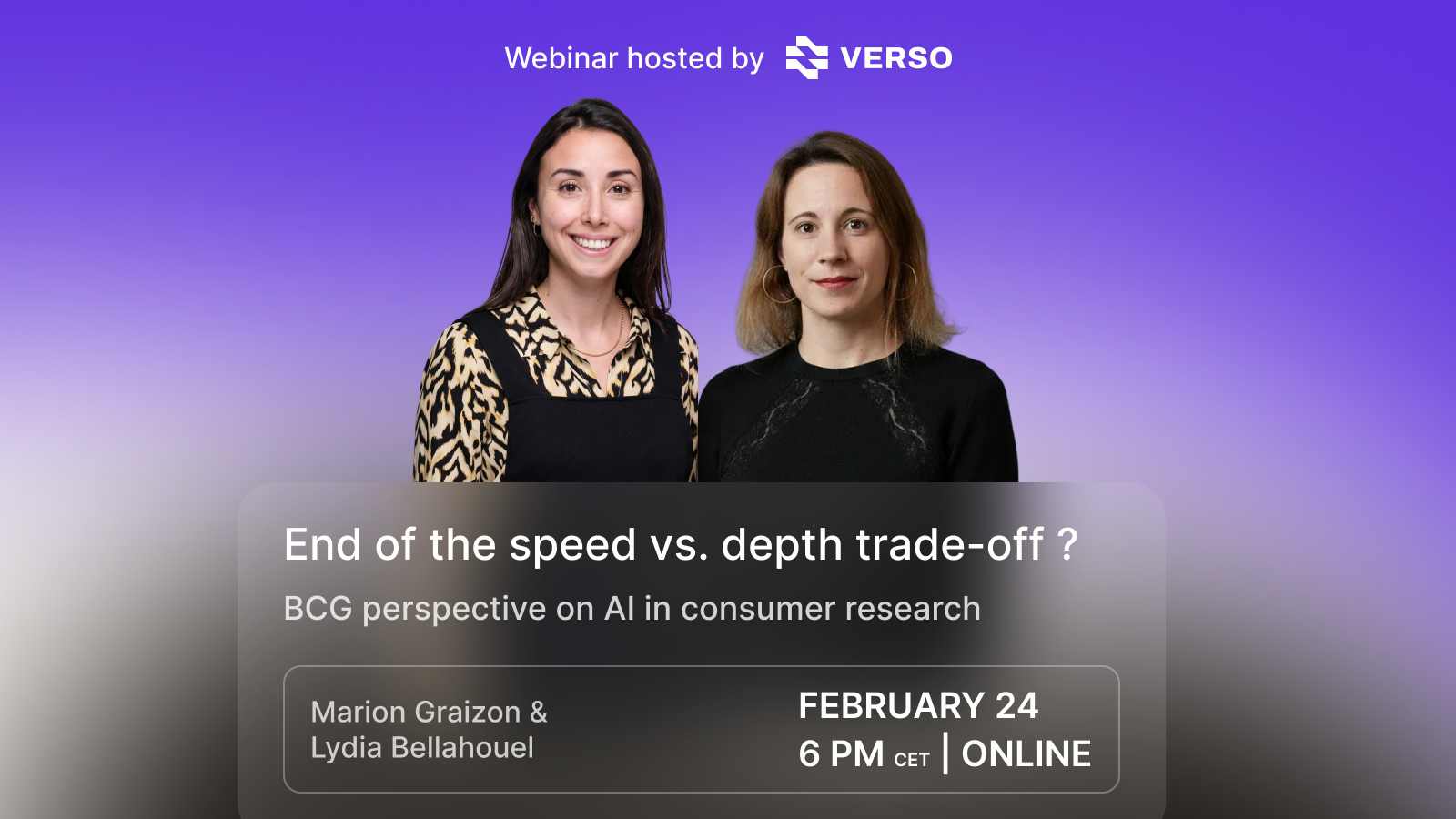
We were lucky to open the very first session of the Verso Insights Academy with Marion Graizon, Managing Director & Partner at BCG, who leads digital transformation work for large consumer organizations and has a front-row seat on how those organizations are rethinking insights right now.
The conversation was less about AI in the abstract and more about what is actually changing inside large insights teams. Here is what stood out.
AI is not just making research faster, it is changing what people expect from research
Marion's framing cut through the usual debate. AI is both an automation play and a net new capability. Not a choice between the two.
- The automation side delivers what everyone talks about: speed and cost savings on existing workflows.
- The net new side is the one people underestimate: research approaches that simply were not viable before, now sitting on the table.
The downstream effect is that executive leaders now expect real-time, integrated insights. Once a CMO or a CEO has seen an answer surface in a day instead of six weeks, the old cadence stops making sense to them.
Adoption is uneven, but the leading organizations are past experimentation
We tend to talk about AI adoption as if every insights team were at the same stage while they are not.
- Tech and CPG are ahead.
- The most mature teams have already moved past proof-of-concept land and are rethinking how research fits into their entire workflow, not running isolated pilots.
- A long tail of teams are still in early experimentation, often with budget allocated but no clear point of view on where AI should and should not sit.
Marion's caution was on synthetic consumers. They are promising, not a silver bullet. The useful question is not "real or synthetic" but which use cases warrant which approach, and where the rigor bar should be set.
The real shift: insights teams' role inside the organization
This was the part of the conversation we keep coming back to.
As insights become more accessible across the org (via AI tools that anyone can prompt), the central question stops being "how do we adopt this tech?" and becomes "what is the role of an insights team now?"
Our shared view, with Marion's input: less about producing reports, more about framing the right questions, guiding decisions, and maintaining rigor. The deliverable changes. The function does not. If anything, it becomes more strategic, not less.
The risk and the opportunity
One line from Marion has stuck with us since:
"The risk is not that AI replaces research. It is that AI makes bad research easier."
Bad research at the speed of light is still bad research, just more of it. The teams worth watching are not the ones plugging AI into the same studies they have always run. They are the ones using the saved time to ask sharper questions earlier, push back harder on the brief, and spend more energy on the call with stakeholders than on the deck.
What comes next
This was Episode 1. The Verso Insights Academy continues with new guests and new topics, focused on the operational realities of running insights teams in 2026.
Here is the link to the highlights.